Introduction
An advertising banner is one of the most effective promotional tools because it combines an attractive design with a message that can be understood quickly, helping capture customers’ attention within seconds.
Whether you are exhibiting at a trade show, opening a new branch or promoting a special offer, choosing the right banner can make a significant difference to the success of your marketing campaign.
In this guide, we explore the most common banner types, the best use for each one, and how to choose the right material and design for your business.
What Is an Advertising Banner?
A banner is a printed advertising medium used to display:
- The company name.
- Offers and discounts.
- Products and services.
- Visual brand identity.
- Marketing messages.
- Event and exhibition information.
Banners are easy to transport, install and use in different locations.
Why Are Banners Such an Effective Advertising Tool?
Despite the growth of digital advertising, banners remain valuable because they:
- Capture attention quickly.
- Work continuously without an internet connection.
- Are suitable for both indoor and outdoor use.
- Are easy to move and reuse.
- Can cost less than running continuous advertising campaigns.
That is why companies use them at exhibitions, conferences, stores and a wide range of events.
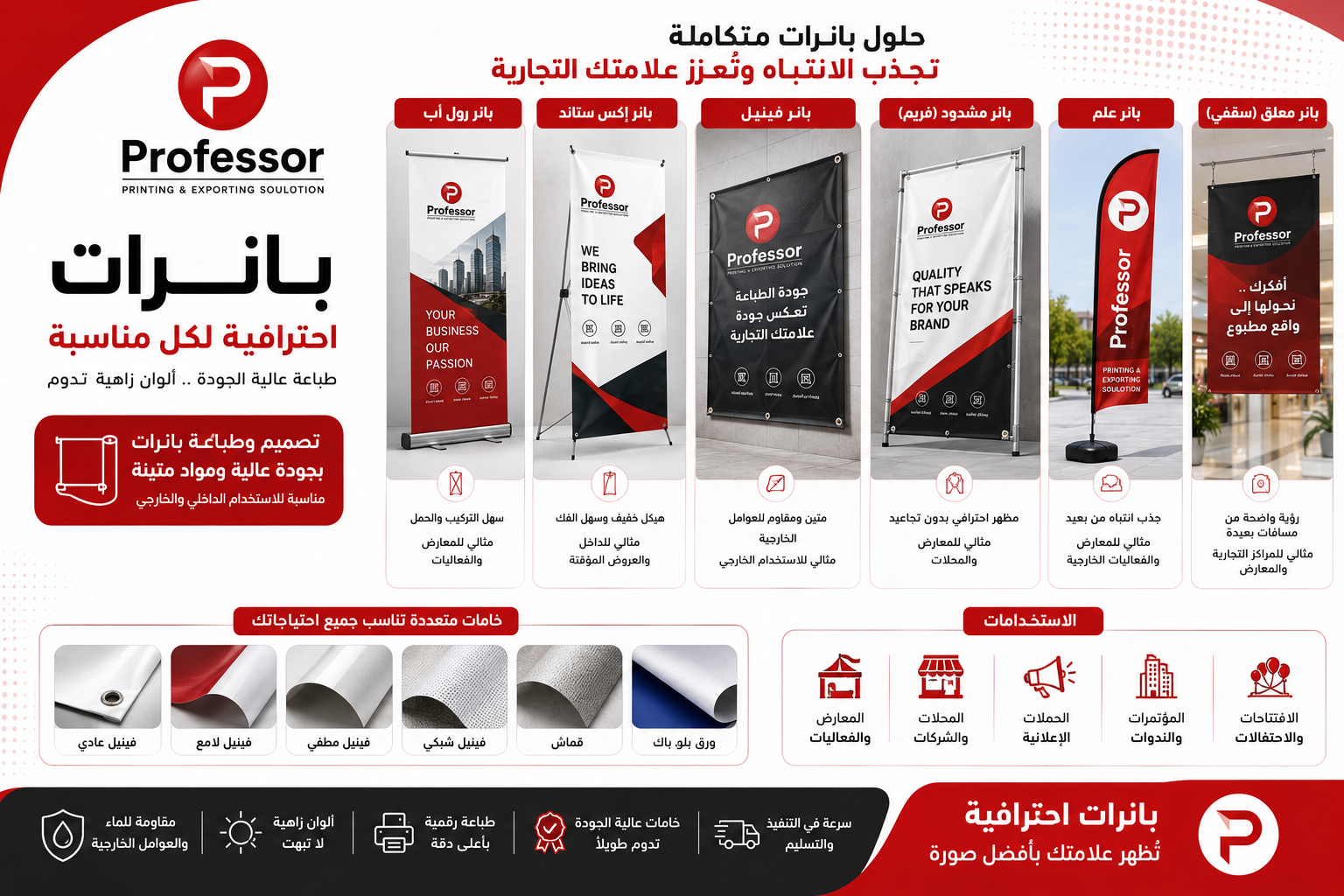
Types of Advertising Banners
There are several types of banners, and the right choice depends on where the banner will be used.
Roll-Up Banner
A roll-up banner is suitable for:
- Exhibitions.
- Companies and business premises.
- Conferences.
- Showrooms.
X Banner
An X banner is suitable for:
- Short-term promotions.
- Retail stores.
- Events.
- Points of sale.
Outdoor Banner
Outdoor banners are used for:
- Streets.
- Shopfronts.
- Construction sites.
- Outdoor campaigns.
Backdrop Banner
Backdrop banners are used for:
- Conferences.
- Opening ceremonies.
- Press conferences.
- Photo sessions.
How Do You Choose the Right Banner Type?
Your choice depends on several factors, including:
- Where the banner will be displayed.
- How long it will be used.
- The required design size.
- How easily it needs to be transported.
- Your budget.
- The nature of the advertising message.
Choosing the right type helps achieve the best impact at the most appropriate cost.
Common Advertising Banner Sizes
The right size depends on the display location and the distance from which customers will view the advertisement.
Some of the most commonly used sizes are:
Roll-Up Banner
- 80 × 200 cm (the most common size)
- 85 × 200 cm
- 100 × 200 cm
- 120 × 200 cm
X Banner
- 60 × 160 cm
- 80 × 180 cm
Backdrop
- 2 × 2 metres
- 3 × 2 metres
- 4 × 3 metres
- Custom sizes according to the event
Outdoor Banner
Outdoor banners can be produced in any size to suit the installation area.
The correct size helps keep the message clear and readable from the intended viewing distance.
What Is the Best Material for Banner Printing?
Banner quality depends greatly on the material used.
Common banner materials include:
Frontlit Flex
This is widely used for outdoor advertising. It is durable and economical.
Blockout Banner
Blockout material prevents light from showing through from the back, making it suitable for locations with strong lighting.
Fabric Banner
Fabric gives a premium appearance and is frequently used at exhibitions, conferences and indoor events.
Canvas
Canvas is used for artistic displays, décor and premium exhibitions.
The right material depends on the display location and how long the banner is expected to remain in use.
The Difference Between Indoor and Outdoor Banners
Before producing a banner, decide where it will be used.
Indoor Banners
Indoor banners are suitable for:
- Companies.
- Exhibitions.
- Conferences.
- Shopping malls.
- Showrooms.
They place particular emphasis on print quality and colour accuracy.
Outdoor Banners
Outdoor banners are suitable for:
- Shopfronts.
- Streets.
- Fences.
- Construction sites.
- Outdoor advertising.
They should be able to withstand:
- Sunlight.
- Rain.
- Wind.
- Extended periods of use.
What Makes a Banner Design Successful?
A banner is different from a flyer or catalogue because customers may only see it for a few seconds.
It should therefore include:
- A large, clear headline.
- A strong image.
- A short message.
- Coordinated colours.
- The company logo.
- Clear contact information.
The more concise the message, the easier it is for customers to remember.
Where Can Banners Deliver the Best Results?
Banners can be used in many locations, including:
- Trade exhibitions.
- Conferences.
- Company entrances.
- Shopfronts.
- Shopping centres.
- Points of sale (POS).
- Events and celebrations.
- Opening ceremonies.
Choosing the right location increases the number of people who see the advertisement and can improve the return on investment.
Mistake 1: Putting Too Much Text on the Banner
A banner is not a booklet or catalogue. People passing by are unlikely to stop and read long paragraphs.
A banner should ideally contain:
- One strong headline.
- A short supporting statement.
- The most important benefit or offer.
- Clear contact information.
A concise message is understood more quickly.
Mistake 2: Using Low-Resolution Images
One of the most common reasons a banner looks unprofessional is the use of small images or low-quality images downloaded from the internet.
Make sure to use:
- Original images.
- A resolution of at least 150–300 DPI, depending on the banner size.
- Clear, coordinated colours.
- Images that are relevant to your business.
A good image immediately communicates the quality of your brand.
Mistake 3: Choosing a Hard-to-Read Typeface
A typeface may look attractive on a computer screen but become difficult to read when the banner is viewed from a distance.
Choose fonts that are:
- Clear.
- Relatively bold.
- Easy to read.
- Consistent with your visual identity.
Avoid using more than two typefaces in one design.
Place the Most Important Message at the Top of the Banner
People often notice the upper part of a banner first, so place the following near the top:
- The company name or logo.
- The main headline.
- The most important marketing message.
Additional details can be placed in the middle or lower part of the design.
Leave Safe Margins Around the Design
Placing text or the logo too close to the edges can cause important parts of the design to be lost during finishing or installation.
It is therefore best to leave:
- An internal safe area of at least 5–10 cm, depending on the banner size.
- All important elements inside this safe area.
- Background artwork extending to the design edges, with bleed for printing.
These precautions help prevent important elements from being trimmed during finishing or installation.
Make Contact Details Easy to Find
After attracting attention, the banner should make it clear how customers can contact you.
Consider including:
- A phone number.
- WhatsApp.
- Your website.
- A QR Code.
- Social media accounts, when needed.
Do not make contact details too small or hide them in a corner.
Banner Pre-Press Checklist
Before approving the design, check the following:
✔ All images have suitable print resolution.
✔ The file uses the CMYK colour mode.
✔ Fonts are converted to outlines or embedded in the file.
✔ Bleed is added where required.
✔ Phone numbers and contact details have been checked.
✔ The logo is clear and legible.
✔ All text has been proofread.
✔ The final dimensions are correct.
✔ The file is saved as a print-ready PDF.
These simple checks prevent many printing problems and help ensure that the finished banner looks as intended.
How Can You Make a Banner Last Longer?
If you plan to use a banner more than once, proper care will help keep it in good condition.
Here are a few tips:
- Roll the banner instead of folding it.
- Store it in a dry place away from moisture.
- Avoid leaving it in direct sunlight for long periods if it is not designed for outdoor use.
- Use the carrying case supplied with a roll-up banner when transporting it.
- Clean the material with a soft cloth and avoid harsh chemicals.
Proper care allows you to reuse a banner at multiple events without having to reprint it.
Frequently Asked Questions
What Is the Difference Between a Roll-Up Banner and an X Banner?
A roll-up banner has a more finished appearance and is easy to set up, while an X banner is an economical option for short-term events.
Can a Banner Be Used Outdoors?
Yes, provided you choose a material designed for outdoor use that can withstand sunlight and weather conditions.
What Is the Best Size for Exhibitions?
The 80 × 200 cm size is one of the most widely used options at exhibitions and conferences.
Can a Banner Be Printed with One Large Image?
Yes, as long as the image has sufficient resolution for the required print size.
Can a Banner Be Reused?
Yes. Reuse is possible, especially when a good-quality material is selected and the banner is stored properly after each use.
Does the Material Depend on Where the Banner Will Be Used?
Absolutely. Outdoor banners require more durable materials than indoor banners.
Can a QR Code Be Added to a Banner?
Yes. A QR Code is a useful way to direct customers to your website, contact page or service enquiry form.
How Long Does Banner Production Take?
It depends on the size, quantity and material. In many cases, production can be completed within a short time after the design is approved.
Why Choose Professor Print for Banner Printing?
At Professor Print, we provide complete banner design and printing solutions across different banner types, with a focus on quality and efficient production.
Our services include:
- Professional designs that attract attention.
- Quality materials for indoor and outdoor use.
- Accurate printing with clear colours.
- A range of sizes to suit your requirements.
- Fast production with careful pre-print checks.
- Competitive pricing for projects of different sizes.
Make Your Advertisement the First Thing Customers Notice
Whether you are preparing for an exhibition, a marketing campaign or the opening of a new branch, a professionally produced banner is one of the quickest ways to attract attention and communicate your message.
Contact the Professor Print team today. We will help you choose the right design, material and size for the result you want.