Introduction
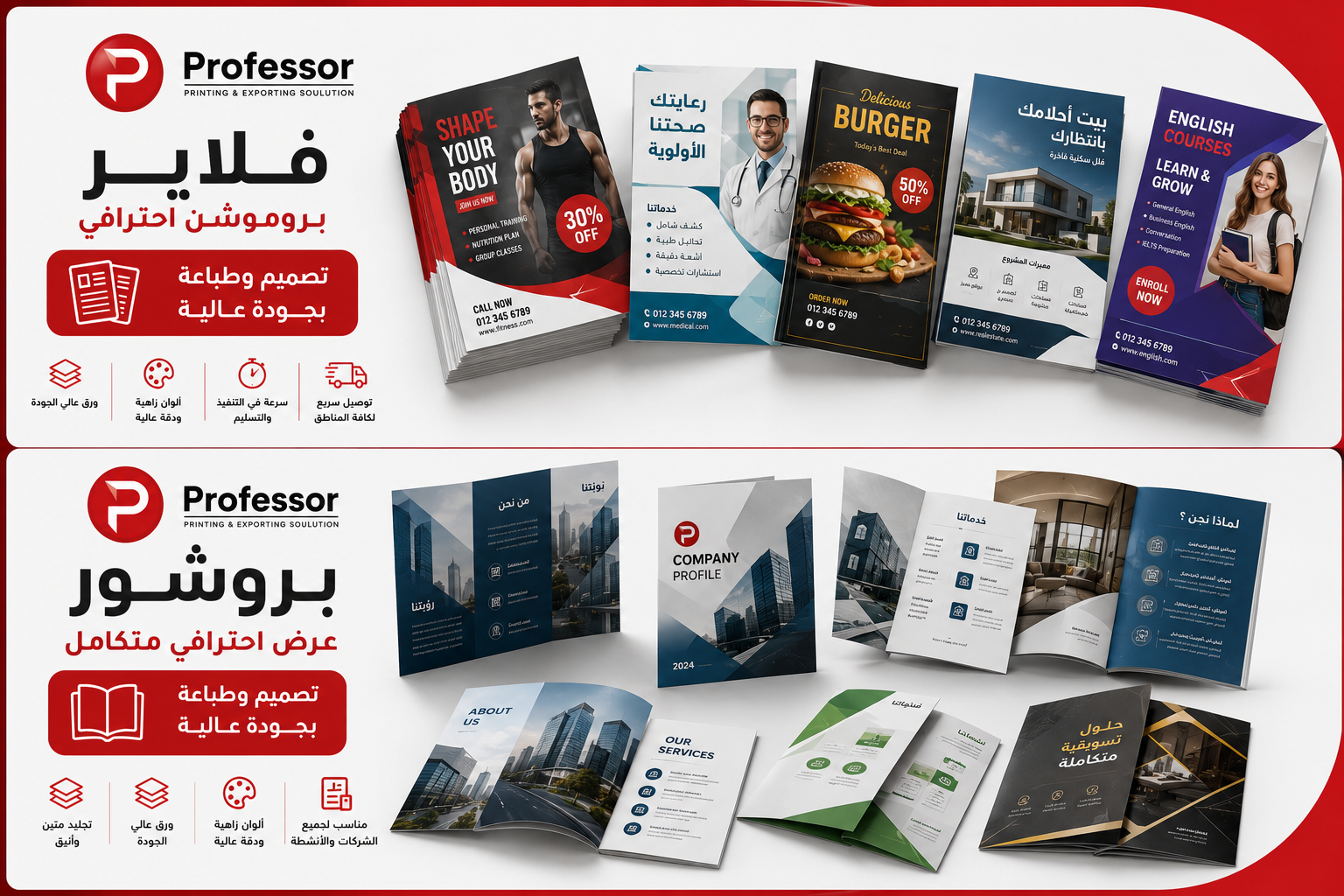
Choosing the size of a flyer or brochure is not an arbitrary decision. It directly affects printing cost, how easily the material can be distributed, how the content is presented and the customer experience.
Choosing a size that is larger than necessary can increase costs without adding value, while a size that is too small can make the design crowded and the information difficult to read.
This guide explains the most common sizes used in Egypt, the advantages of each size and its best applications for different businesses.
Why Is Choosing the Right Size Important?
The right size helps to:
- Improve the reading experience.
- Organise information professionally.
- Reduce printing costs.
- Make distribution easier.
- Present the design attractively.
It is therefore best to define the amount of content and the target audience before choosing the final size.
A6 Size
A6 is one of the smallest and most practical sizes when you need to communicate a short promotional message.
Best applications:
- Discount coupons.
- Invitation cards.
- Quick offers.
- Local campaigns.
Advantages
- Low cost.
- Easy to carry.
- Quick to distribute.
- Suitable for large quantities.
A5 Size
A5 is one of the most widely used sizes for advertising campaigns because it provides good space for content while remaining easy to distribute.
Best applications:
- Restaurant offers.
- Retail promotions.
- Services.
- Events.
- Marketing campaigns.
A4 Size
A4 is used when you need to present more information or include several images and design elements without making the layout feel crowded.
Best applications:
- Service lists.
- Small catalogues.
- Company profiles and introductions.
- Detailed offers.
- Schools and training centres.
Advantages
- Generous space for content.
- Suitable for image-rich designs.
- Can be folded into a brochure.
- Creates a professional impression.
DL Size
DL has an elegant, elongated shape and is used when the content is concise and needs a professional presentation.
Best applications:
- Event invitations.
- Hotel offers.
- Corporate offers.
- Price lists.
- Special offers.
Advantages
- Elegant design.
- Easy to carry.
- Fits standard envelopes.
- Provides a comfortable reading experience.
Common Brochure Fold Types
Choosing a brochure involves more than its size. The number of folds and the way the content is arranged also matter.
Half Fold
The sheet is folded once to create two panels (four sides when both faces are counted).
Suitable for:
- Company introductions.
- Service lists.
- Simple offers.
Tri-Fold
This is one of the most widely used brochure formats.
Suitable for:
- Companies.
- Clinics.
- Restaurants.
- Tourism.
It helps divide information into clear, easy-to-read panels.
Z-Fold
A Z-fold brochure creates a different opening experience and is often used for modern marketing campaigns.
Gate Fold
Gate-fold brochures are used for premium printed materials and new product launches.
A Quick Guide to Choosing the Right Size
| Business Type | Suggested Size |
|---|---|
| Restaurants and cafés | A5 or DL |
| Retail offers | A5 |
| Schools | A4 |
| Companies | A4 tri-fold |
| Clinics | Tri-fold |
| Real estate | A4 |
| Exhibitions | A5 or A4 |
| Hotels | DL |
This table helps you select a size based on the type of business.
How Does Size Affect Printing Cost?
As the printed piece gets larger, it uses more paper, which may increase printing cost. However, choosing the smallest size is not always the best solution: crowded content can make an advertisement less effective and harm the reader’s experience.
You should therefore balance the amount of content, the distribution method and the budget to achieve the best result.
Choose the Size According to the Amount of Content
Before choosing a size, ask yourself:
- Do you have only one offer to communicate?
- Do you need to present a list of services?
- Will the design include many images?
- Does the customer need to read a lot of detail?
If the information is brief, an A5 or A6 flyer is often sufficient.
If you need to present detailed services or product information, an A4 or tri-fold brochure is usually a better choice.
Common Size-Selection Mistakes
Some of the most common mistakes made by businesses are:
- Choosing a small size for a large amount of text.
- Using a large size for a simple marketing message.
- Ignoring how the printed material will be distributed.
- Overlooking the number of folds and their effect on content layout.
- Reducing the font size just to fit in more information.
These mistakes can make printed material look less professional and reduce the chance that customers will engage with the advertisement.
How Does a Designer Choose the Size?
A professional designer does not start with the dimensions. The first step is to understand the purpose of the printed material.
The designer first asks:
- Who is the target audience?
- Where will the flyer or brochure be distributed?
- What is the most important message the customer should see?
- How many images are required?
- Does the design need folds?
Once these questions have been answered, choosing the size becomes easier and more accurate.
Does Size Affect the Customer Experience?
Yes.
Good printed material does more than attract attention; it should also be easy to read.
The right size helps to:
- Organise information.
- Highlight images.
- Improve the reading experience.
- Make customers more likely to keep the printed piece.
- Improve response to the advertising campaign.
That is why a flyer or brochure’s success depends not only on its design but also on choosing the right size from the beginning.
How Do You Prepare a Flyer or Brochure File for Printing?
Even a well-designed piece can develop problems during printing if the file is not prepared correctly. Make sure to:
- Set the artwork resolution to 300 DPI.
- Use the CMYK colour mode.
- Add at least 3 mm of bleed.
- Convert fonts to outlines or provide the fonts used.
- Use high-resolution images.
- Check all information before sending the file to print.
- Save the file as a print-ready PDF or AI file.
These steps help ensure that the printed result matches the quality of the approved design.
Tips for the Best Result
Before approving the final design, make sure to:
- Use a clear headline that attracts attention.
- Arrange the content according to priority.
- Use professional, high-quality images.
- Avoid using too many colours and typefaces.
- Leave comfortable white space in the layout.
- Add contact details or a QR Code.
- Choose materials and finishes that suit your brand identity.
These details make a flyer or brochure more professional and effective.
Frequently Asked Questions
Is a Larger Size Always Better?
Not necessarily. The right size depends on the amount of content and how the material will be distributed, not simply on its dimensions.
Which Sizes Are Most Commonly Used in Egypt?
A5 is one of the most common flyer sizes, while A4 tri-fold is one of the most widely used brochure formats.
Can the Same Design Be Produced in More Than One Size?
Yes. A design can be adapted to more than one size to suit different marketing campaigns.
Which Brochure Fold Is Best?
The tri-fold is widely used because it organises information into clear, easy-to-read panels.
Does Size Affect the Amount of Paper Used?
Yes. A larger size uses more paper, which may affect the printing cost.
Can a Brochure Be Produced Without Folds?
Yes. A two-sided or four-page brochure can be used, depending on the amount of content.
Does Size Affect Print Quality?
No. Print quality depends on file preparation and material, while size affects only how the content is presented.
How Do I Choose the Right Size?
Consider the amount of information, the target audience and how the flyer or brochure will be distributed.
Why Choose Professor Print for Flyer and Brochure Printing?
At Professor Print, we help you choose the right size, material and finish before production begins. Our aim is to create printed materials that reflect your brand identity and make a strong impression on your customers.
We provide:
- Free advice on choosing the right size.
- Professional designs aligned with your visual identity.
- Printing using modern technologies.
- A range of materials and finishes.
- Efficient production with careful quality control.
- Competitive pricing for projects of different sizes.
Order a Flyer or Brochure in the Right Size for Your Business
If you need a professional flyer or brochure to reach your customers effectively, the Professor Print team is ready to help you choose the right size, material and finish, and deliver high-quality design and printing.
Contact us today for a free consultation and a quotation tailored to your project.